

Comparative wound healing in cultured tissues vs ex-vivo tissues
This study compared a 3D cultured skin model with Ten Bio’s tensioned ex vivo TenSkin model for battlefield wound simulation. Results showed TenSkin more closely replicates healing seen in trauma patients, making it a superior platform for injury research.

Spring Conference Season
As the Northern Hemisphere welcomes Spring 2023 the new season of industry conferences and symposia kicks off. And after the return to face to face

Your Skin Research Partner – Ten Bio
service /ˈsəːvɪs/ Noun: ‘the action of helping or doing work for someone’ A note from the Chair Ten Bio’s early experience with our anchor clients has

Ten Bio named finalist in Scotland’s Life Science award.
Ten Bio is proud to announce that our company has been named one of three finalists in Scotland’s Life Science award in the category ‘Innovation


The origins of TenSkin™
Entering our third year since spin out, it’s time to celebrate the origins of our technology which has brought Ten Bio early success in a

‘When I was two, I was nearly new’ ….
‘When I was two I was nearly new’ … with thanks to A. A. Milne for the line from his 1927 poem ‘Now we are

Our differentiation in wound management….
In the previous note from the chairman I emphasized the potential role for Ten Bio in the area of wound management. My reason for that

Dr Paul Campbell seconded to Ten Bio through UK Medical Research Council Innovation Scholarship
Dr Paul Campbell, Reader in Physics at the University of Dundee has recently begun a secondment to Ten Bio through an Innovation Scholarship funded by the UK’s Medical Research Council.

Proud to be presenting at the Society for Investigative Dermatology Annual Meeting in Portland
May 18-21, 2022 We are proud to be exhibiting and presenting at the Society for Investigative Dermatology annual meeting later this week. Our Founder and
The next frontier in precision dermatology isn’t just molecular, it’s human
Precision dermatology is becoming increasingly sophisticated – but can nonclinical models keep pace? We explore how biological diversity, skin biomechanics and human ex vivo tissue can help translate molecular precision into New Approach Methodologies (NAMs) that accurately represent the responses of human tissue.
Protective effects of antioxidant mix pre-treatment against visible light-induced damage in dark skin phototype
Visible light (VL) accounts for approximately 50% of the solar radiation reaching Earth’s surface and has emerged as a major contributor to skin photoaging and
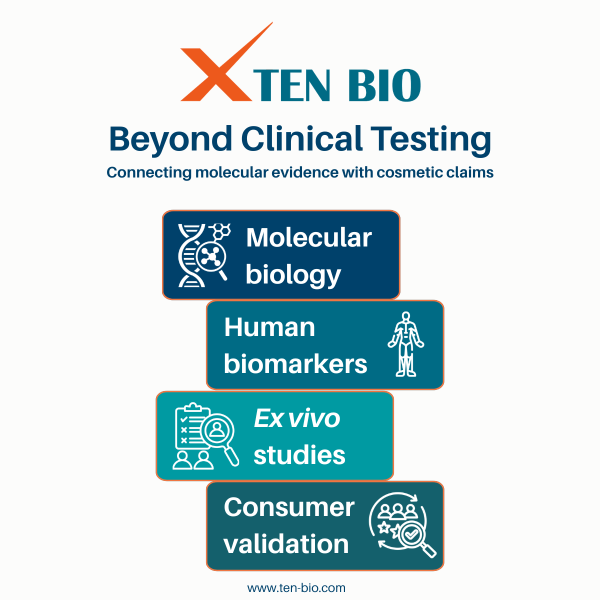
Beyond clinical testing: Why molecular evidence is becoming essential for cosmetic claims
Clinical studies show whether consumers experience measurable product benefits, but they often cannot explain why. In this article, we explore how molecular evidence from ex vivo human skin models are strengthening cosmetic claim substantiation by connecting visible outcomes with the biological mechanisms that drive them.
Can AI improve predictive skin research?
Artificial intelligence is transforming skin research by uncovering biological patterns and predicting tissue responses from increasingly large and complex datasets. But AI is only as reliable as the biological data used to train and validate it. Discover why physiologically relevant human skin models remain essential for translating AI predictions into meaningful biological insight.
Longevity beauty in 2026: From anti-aging claims to biological evidence
Longevity beauty is reshaping the dermo-cosmetics sector, shifting the focus from traditional anti-aging claims toward biologically relevant evidence. As innovations such as peptides, exosomes and microbiome-focused technologies gain momentum, the challenge is no longer simply developing new actives, but demonstrating their impact on skin biology through predictive, human-relevant testing approaches.
From creams to complex molecules: The evolving science of topical delivery
Topical drug delivery has evolved from simple creams to increasingly sophisticated systems designed to transport therapeutic molecules through the skin. While many small molecules can penetrate the skin barrier, larger and more complex therapeutics present new challenges. In this article, we explore how topical and transdermal delivery is evolving and why human-relevant skin models are becoming increasingly important for understanding how new therapies interact with the skin.