Precision dermatology is transforming how therapies are developed. Rather than designing treatments for the average patient, advances in genomics, biomarker discovery, artificial intelligence, and molecular profiling are enabling therapies that account for the biological differences between individuals. This could include an anti-fibrotic therapy tailored for patients whose skin is prone to excessive scarring or a regenerative treatment optimized for aged skin with impaired collagen remodeling. This is already becoming a reality in some areas of dermatology.
Molecular and biomarker profiling already supports more individualized approaches across other dermatological conditions [1]. At the same time, advances in skin modeling are enabling greater biological complexity to be incorporated into nonclinical research [2]. In melanoma, for example, molecular testing can identify specific mutations in genes such as BRAF, which can guide the use of targeted therapies. More recently, individualized neoantigen therapies, sometimes described as personalized cancer vaccines, have taken this concept further by using the unique mutations within a patient’s tumor to design a patient-specific immune response [3].
But as our ability to identify which patients are most likely to benefit improves, another challenge presents itself: can we test those therapies in models that reflect the biology of those patients? As precision dermatology advances, New Approach Methodologies (NAMs) and other human-relevant nonclinical models must evolve alongside it, preserving the biological and biomechanical complexity of human skin needed to translate molecular discoveries into meaningful therapeutic outcomes.
Biological diversity in human skin
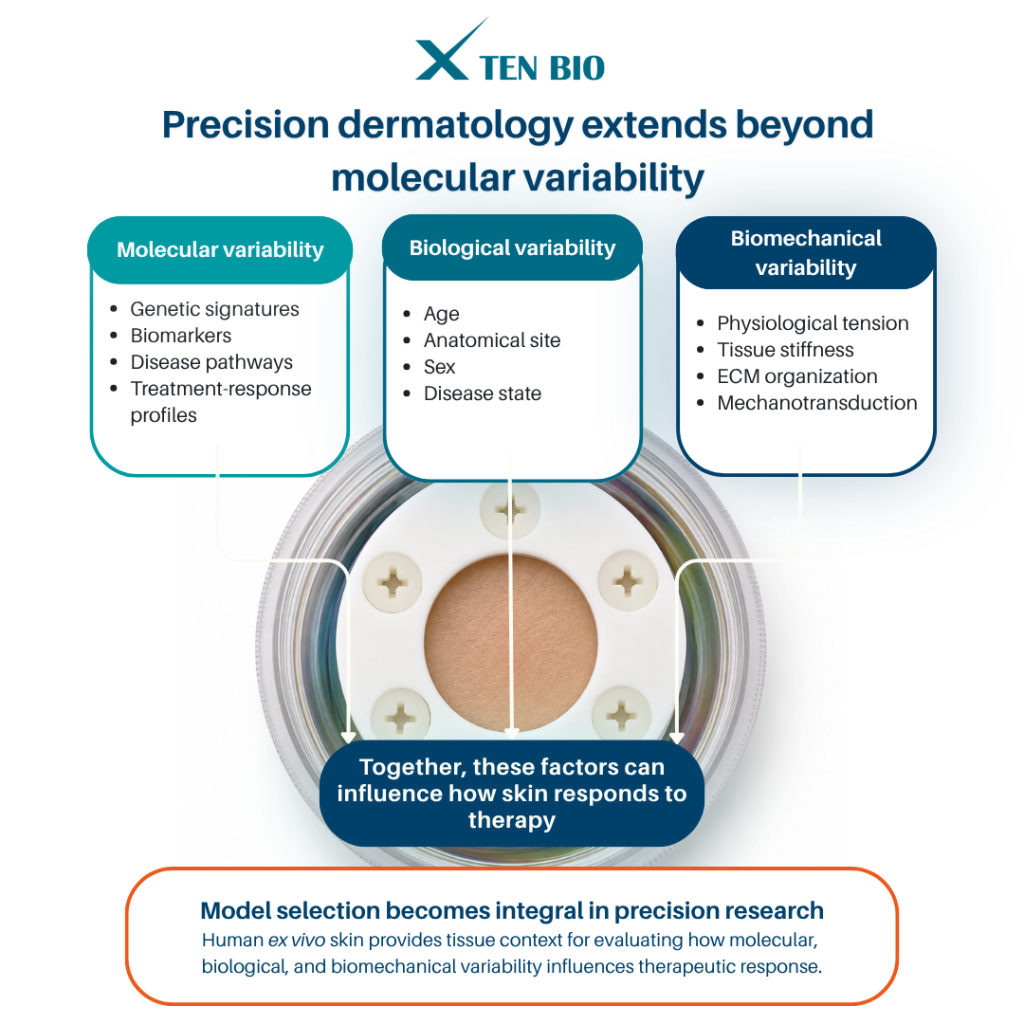
If nonclinical models are to support precision dermatology, they must also reflect the biological diversity of human skin. Importantly, this variability is not only molecular. Human skin also differs structurally and mechanically, and these differences can influence how tissue responds to treatment.
Human skin can vary across age, anatomical location, ethnicity, hormonal state, metabolic health, and disease status. A postmenopausal patient, for example, may experience reduced collagen synthesis, altered extracellular matrix organization, and diminished skin elasticity [4]. Likewise, rapid weight loss associated with the increasing use of GLP-1 receptor agonists may alter the mechanical environment of the skin [5].
In precision research, these donor characteristics are not simply background variation. Age, anatomical site, hormonal status, disease state, and other biological features can be considered experimental variables that may help explain differences in tissue response.
A missing dimension: Skin biomechanics
Among the many sources of biological variation in human skin, one remains surprisingly underappreciated: biomechanics.
Skin is constantly subjected to tension, compression, and stretch. These physical forces regulate cellular behavior through mechanotransduction pathways that influence fibroblast activity, collagen remodeling, inflammatory signaling, and tissue regeneration. Alterations in mechanical tension accompany aging, fibrosis, wound healing, rapid weight loss, and many chronic skin disorders [6].
In other words, two skin samples with similar molecular profiles may behave differently because their biomechanical properties are different.
From molecular precision to tissue-level validation
Tissue-level validation is particularly relevant in precision dermatology, because researchers need to understand not only whether a molecular pathway is affected, but how that response behaves within intact human tissue.
Different nonclinical models can provide different levels of biological complexity. Two-dimensional cell cultures are valuable for controlled mechanistic studies, reconstructed and 3D skin models introduce greater tissue organization, and human ex vivo skin adds another level of complexity by retaining native human tissue architecture and extracellular matrix [2].
Among the available approaches, human ex vivo skin models can provide this additional tissue context. TenSkin™, for example, maintains intact human skin under physiological tension, allowing therapeutic responses to be studied while retaining native tissue architecture, extracellular matrix, resident cell populations, and an important aspect of the skin’s biomechanical profile.
Importantly, these models also support studies across diverse donor populations and clinically relevant tissue states, allowing biological variability observed across patients to be incorporated into experimental design.
Human ex vivo skin can complement molecular profiling by providing the tissue context needed to understand how molecular discoveries translate into human biology. For example, a potential precision dermatology workflow could begin by identifying a molecular feature associated with treatment response, such as a biomarker or pathway linked to fibrosis. That finding could then be tested across human skin samples representing different biological states, including differences in age, disease status, or mechanical properties. Researchers could assess molecular changes alongside functional and structural responses to determine whether the candidate therapy produces the expected effect in the tissue.

Testing candidates across different biological states can help reveal whether molecular effects are maintained across human tissue environments and which donor or tissue characteristics may influence treatment response.
This changes the questions researchers need to ask. Instead of simply asking, does this therapy work? They must also consider:
- Does it work in aged skin?
- Does it perform similarly across diverse donor populations?
- How does it behave in tissue with altered mechanical properties?
- Which patients are most likely to benefit?
The future of precision dermatology
Precision dermatology is increasingly defined by advances in biomarkers, sequencing technologies, and personalized therapeutics, but true precision also depends on understanding the tissue in which those therapies must function. As treatments become more targeted, nonclinical research must reflect the biological and biomechanical diversity of human skin, helping researchers understand not only which molecules matter, but how they behave within different tissue environments. Combining molecular precision with human tissue relevance can therefore create a more predictive path from discovery to clinical success.
References
[1] Tan, I. J., Podwojniak, A., Parikh, A., & Cohen, B. A. (2024). Precision Dermatology: A Review of Molecular Biomarkers and Personalized Therapies. Current Issues in Molecular Biology, 46(4), 2975-2990. https://doi.org/10.3390/cimb46040186
[2] Quílez, C., et al. (2024). Targeting the complexity of in vitro skin models: A review of cutting-edge developments. Journal of Investigative Dermatology, 144(12), 2650–2670. https://doi.org/10.1016/j.jid.2024.04.032
[3] Reitmajer M, Flatz L. Precision medicine in cutaneous melanoma—A comprehensive review. J Eur Acad Dermatol Venereol. 2026; 40: 377–386. https://doi.org/10.1111/jdv.70111
[4] Arbex, P., & Lephart, E. D. (2026). Collagen, curcumin, and glutathione to enhance dermal health in aging women with declining estrogen levels—A narrative review. Dermatology and Therapy, 16, 2705–2729. https://doi.org/10.1007/s13555-026-01731-z
[5] Kruglikov I. L. (2025). Mechanisms of Glucagon-Like Peptide 1 Receptor Agonist-Induced Facial Lipodystrophy and a Path Toward Prevention. Journal of cosmetic dermatology, 24(12), e70584. https://doi.org/10.1111/jocd.70584
[6] Pambianchi, E., Hagenberg, Z., Pecorelli, A. et al. Tension as a key factor in skin responses to pollution. Sci Rep 13, 16013 (2023). https://doi.org/10.1038/s41598-023-42629-6
Ten Bio Team October 2026