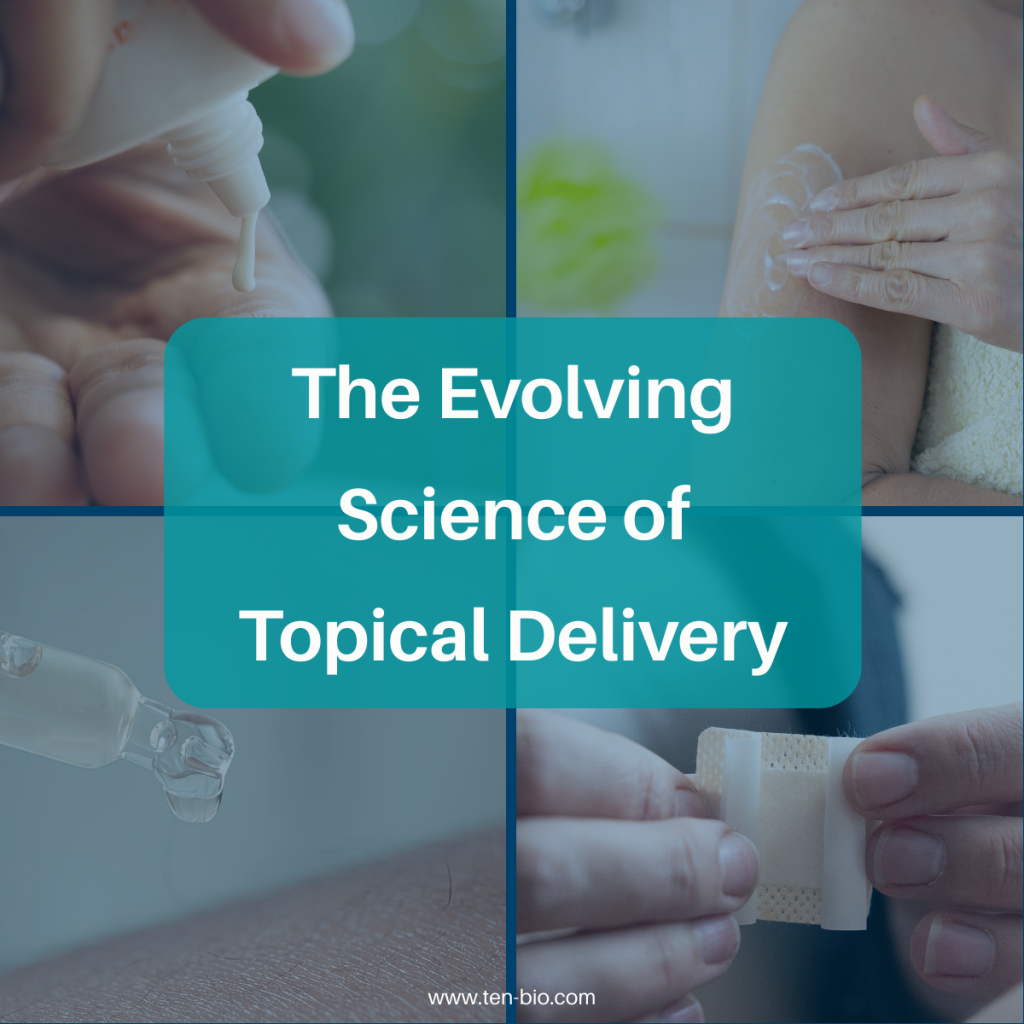
For centuries, people have relied on the skin as a pathway for therapeutic delivery, from ancient ointments and herbal salves to modern medicated creams and transdermal patches. Its accessibility enables localized treatment within the skin as well as systemic delivery when active ingredients cross the cutaneous barrier and enter circulation.
Early topical medicines were primarily designed to soothe or protect the skin’s surface. Over time, however, it became clear that certain molecules could penetrate beyond the stratum corneum and reach viable epidermal and dermal tissue. This recognition transformed the skin from a passive surface into an active route for therapeutic delivery.
Today, topical and transdermal drug delivery is a well-established component of modern medicine. Applications range from dermatological therapies targeting inflammatory skin disease to transdermal systems delivering hormones, nicotine, and analgesics into systemic circulation. These approaches offer several advantages, including localized drug exposure, avoidance of first-pass metabolism, and sustained release profiles.
Central to this field is the barrier function of the stratum corneum. This outermost layer of the skin consists of corneocytes embedded in a highly organized lipid matrix composed primarily of ceramides, cholesterol, and free fatty acids. This “brick-and-mortar” structure is highly effective at both limiting water loss and the penetration of exogenous compounds. As a result, passive diffusion across intact skin is restricted to molecules with specific physicochemical properties.
One of the most widely cited principles in topical delivery is the “500 Dalton Rule”, which states that compounds larger than approximately 500 Daltons (Da) rarely penetrate intact human skin by passive diffusion. In practice, this constrains effective passive delivery to small, moderately lipophilic molecules with limited hydrogen bonding capacity. While not absolute, the rule remains a useful benchmark for understanding the inherent selectivity of the skin barrier and the challenges associated with delivering larger or more complex therapeutics.
To overcome these limitations, advances in formulation science have focused on modifying drug-skin interactions and enhancing transport across the barrier. Strategies include lipid-based carriers such as liposomes, solid lipid nanoparticles (SLNs), and nanostructured lipid carriers (NLCs), as well as nano- and micro-emulsions, vesicular systems, hydrogels, and chemical penetration enhancers. These technologies aim to improve drug solubilization, alter partitioning into the stratum corneum, and enhance diffusion through intercellular lipid pathways.
More recently, artificial intelligence and machine learning approaches are being applied to topical formulation development, enabling prediction of skin permeability, optimization of formulation composition, and identification of novel delivery systems beyond traditional trial-and-error approaches. As these methods evolve, they offer the potential to accelerate development and uncover previously inaccessible formulation design spaces.
In parallel, physical delivery technologies have emerged to bypass or transiently disrupt the barrier. Approaches such as microneedles, electroporation, iontophoresis, and thermal ablation create transient pathways that enable delivery of larger and more hydrophilic molecules, including peptides, proteins, and nucleic acids. These strategies are expanding the scope of topical delivery beyond traditional small molecules toward more complex biologic therapeutics.
While current technologies work well for many conventional drugs, the next frontier presents a greater challenge. Increasingly, pharmaceutical research is focusing on large and complex molecules, including peptides, proteins, and nucleic acids. These biologically active molecules offer the possibility of targeting disease pathways with greater specificity than traditional small molecules.
However, their physical properties make them difficult to deliver through the skin. Large molecular size, hydrophilicity, and structural instability all limit their ability to cross the stratum corneum. Even when employing advanced delivery strategies, such as microneedles, electroporation, or novel carrier systems, predicting how these molecules interact with human skin remains a complex task.
This shift towards more sophisticated delivery technologies makes predicting transport across human skin increasingly challenging and difficult to replicate in simplified in vitro models and simplified skin systems. As delivery technologies become more complex, understanding how molecules are transported across intact, functional skin tissue becomes crucial for predicting, efficacy, dosing and safety.
Alongside scientific progress, regulatory frameworks have evolved to evaluate how topical and transdermal products behave within the body. Regulators assess not only safety and efficacy, but also the site of action of the active ingredient. Some products are designed to act locally within the skin, as in dermatological treatments or cosmetics. Others are intended to deliver drugs systemically via transdermal absorption.
Demonstrating reliable and reproducible delivery across the skin barrier is therefore a critical component of development. Researchers must show where the active ingredient distributes within the skin, amounts released into circulation, and how consistently this occurs across different individuals and conditions.
Addressing these questions requires experimental systems that accurately represent the biology of human skin on the body, including its architecture, mechanical properties, physiology and cellular interactions.
At Ten Bio, we are supporting this next stage of innovation through TenSkin™, a physiologically relevant human skin platform designed to maintain the structure and mechanical properties of native skin tissue. By preserving tissue tension and the full architecture of human skin, TenSkin™ enables researchers to investigate topical and transdermal delivery in conditions that more accurately represent the in vivo environment.
This type of human-relevant platform allows developers to explore how both traditional small molecules and emerging biologic therapeutics interact with the skin barrier, helping to generate more reliable data on penetration, distribution, and therapeutic activity.
As the field continues to evolve, from simple creams to increasingly complex molecular therapies, the ability to study drug delivery in realistic human skin systems will play a key role in translating scientific advances into safe and effective treatments.
Ten Bio Team April 2026
References
Yu YQ, Yang X, Wu XF, Fan YB. Enhancing Permeation of Drug Molecules Across the Skin via Delivery in Nanocarriers: Novel Strategies for Effective Transdermal Applications. Front Bioeng Biotechnol. 2021 Mar 29;9:646554. doi: 10.3389/fbioe.2021.646554. PMID: 33855015; PMCID: PMC8039394.
Adnan M, Akhter MH, Afzal O, Altamimi ASA, Ahmad I, Alossaimi MA, Jaremko M, Emwas AH, Haider T, Haider MF. Exploring Nanocarriers as Treatment Modalities for Skin Cancer. Molecules. 2023 Aug 5;28(15):5905. doi: 10.3390/molecules28155905. PMID: 37570875; PMCID: PMC10421083.