

Happy Holidays 2023!
The Ten Bio team wishes you Happy Holidays and a Prosperous New Year! As our successful year comes to a close, we would like to thank our clients and business partners for their continued confidence, trust and engagement. We look forward to strengthening our collaborations in 2024 and are excited by the prospect of new partnerships and by the new science that will emerge in the coming year.

Bring me sunshine!
Exploring the effects of sun exposure using explant skin. Enjoyment of sunshine is a quintessential aspect of the human experience. Exposure provides a myriad of

Tension as a key factor in skin responses to pollution
This study explores how physiological tension affects skin responses to ozone pollution using the TenSkin™ model. Findings reveal tension modulates the expression of antimicrobial peptides and markers of oxidative stress and inflammation, highlighting its importance in skin health studies.

Advances and Opportunities in (Pre)Clinical Testing for Cosmetics and Personal Care
We are pleased to share this Global Perspectives Column in EURO COSMETICS Mag written by Deanna Utroske. Ten Bio emphasises scientific discipline and rigour in all of our

Scientific Conferences R Ten Bio
Since Ten Bio launched in the autumn of 2020 our attendance at conferences, symposia etc. has been the central plank to our market engagement strategy.

TenSkin™– its role in reducing animal testing in skin research.
TenSkinᵀᴹ – its role in reducing animal testing in skin research. Generate more predictive preclinical data without animal testing.

Mechanical tension influences the immunocompetency of ex vivo skin tissue
Human-relevant testing methods using donated skin tissue offer a promising alternative to animal models. Our ex vivo culture system restores physiological tension in skin, preserving structure, function, and immune cells like Langerhans cells, enabling immune activation studies for up to seven days.

TenSkin™ – The perfect platform for microneedle applications.
Dr Paul Campbell gives his perspective on potential research avenues with TenSkin™. ‘Having worked directly with the company whilst on secondment over the past year,

Ten Bio is in Japan!
Ten Bio 社は日本にあります. In May this year, Ten Bio will attend the global session of the International Societies for Investigative Dermatology (ISID) to be held

TenSkin™ – the number one choice for skin research
Professor Giuseppe Valacchi has a global reputation for his work in expanding the understanding of cellular and molecular mechanisms that define the physio-pathological responses of skin tissue. In this interview, Professor Valacchi describes why TenSkinTM is his first choice for skin research and why he is pleased to lead Ten Bio’s Scientific Advisory Board . .
The next frontier in precision dermatology isn’t just molecular, it’s human
Precision dermatology is becoming increasingly sophisticated – but can nonclinical models keep pace? We explore how biological diversity, skin biomechanics and human ex vivo tissue can help translate molecular precision into New Approach Methodologies (NAMs) that accurately represent the responses of human tissue.
Protective effects of antioxidant mix pre-treatment against visible light-induced damage in dark skin phototype
Visible light (VL) accounts for approximately 50% of the solar radiation reaching Earth’s surface and has emerged as a major contributor to skin photoaging and
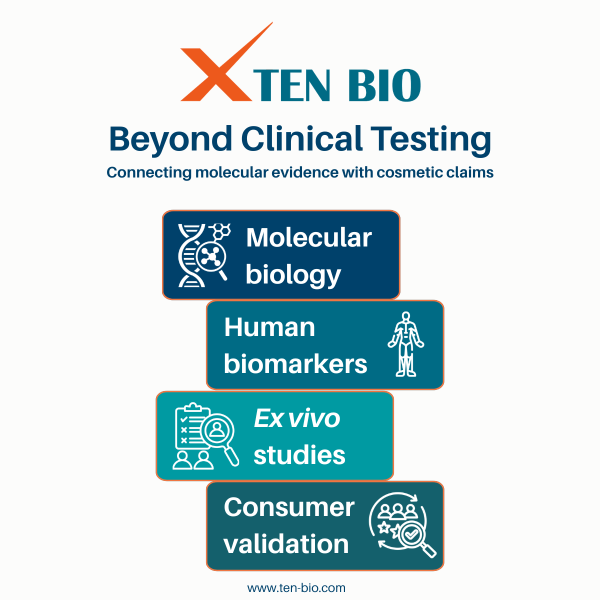
Beyond clinical testing: Why molecular evidence is becoming essential for cosmetic claims
Clinical studies show whether consumers experience measurable product benefits, but they often cannot explain why. In this article, we explore how molecular evidence from ex vivo human skin models are strengthening cosmetic claim substantiation by connecting visible outcomes with the biological mechanisms that drive them.
Can AI improve predictive skin research?
Artificial intelligence is transforming skin research by uncovering biological patterns and predicting tissue responses from increasingly large and complex datasets. But AI is only as reliable as the biological data used to train and validate it. Discover why physiologically relevant human skin models remain essential for translating AI predictions into meaningful biological insight.
Longevity beauty in 2026: From anti-aging claims to biological evidence
Longevity beauty is reshaping the dermo-cosmetics sector, shifting the focus from traditional anti-aging claims toward biologically relevant evidence. As innovations such as peptides, exosomes and microbiome-focused technologies gain momentum, the challenge is no longer simply developing new actives, but demonstrating their impact on skin biology through predictive, human-relevant testing approaches.
From creams to complex molecules: The evolving science of topical delivery
Topical drug delivery has evolved from simple creams to increasingly sophisticated systems designed to transport therapeutic molecules through the skin. While many small molecules can penetrate the skin barrier, larger and more complex therapeutics present new challenges. In this article, we explore how topical and transdermal delivery is evolving and why human-relevant skin models are becoming increasingly important for understanding how new therapies interact with the skin.