Introduction: The evolution of cosmetic claim substantiation
Cosmetic claim substantiation is evolving. Clinical studies can provide valuable evidence of visible product efficacy in people, but they do not always explain the biological mechanisms behind those results. Advances in molecular biology and human-relevant skin models now allow researchers to measure how products work, providing a deeper layer of evidence that strengthens cosmetic claims.
This shift is reflected in the global cosmetic market. In 2025, skincare accounted for 57.9% of the global cosmetic efficacy testing market. ¹ As cosmetic science becomes increasingly biology-driven, brands are looking beyond visible outcomes alone. Claims relating to processes such as collagen production, barrier function or inflammatory pathways require evidence capable of demonstrating biologically plausible effects, not simply changes in appearance.²
Cosmetic claim substantiation is evolving and recent developments have also enabled the scientific community to apply AI to tasks such as image analysis, biomarker discovery, target identification, therapeutic response prediction, and the interpretation of complex biological datasets.3 While these technologies are accelerating hypothesis generation and product development, they also raise an important question: how do we translate AI-generated predictions into scientifically substantiated cosmetic claims?
Why clinical testing alone is no longer enough
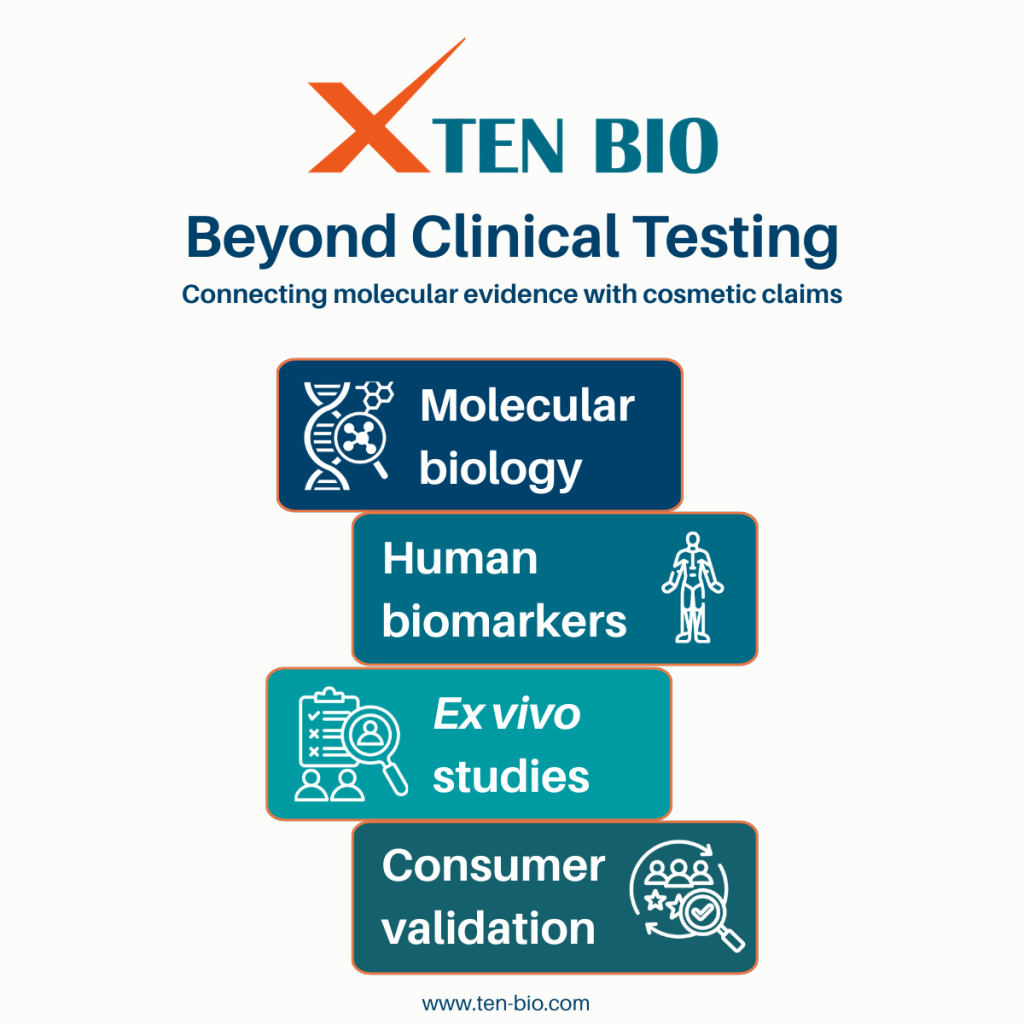
For claims focused on visible or consumer-relevant outcomes, clinical studies can provide important evidence of product performance, but they often provide limited insight into the biological mechanisms driving those outcomes. Increasingly, retailers, regulators, dermatologists, investors, and consumers are seeking evidence that links visible improvements to measurable biological responses.
Cosmetic efficacy testing has traditionally placed considerable emphasis on demonstrating observable product benefits. Molecular and cellular approaches add another dimension: they allow researchers to investigate the biological pathways associated with those outcomes. In vitro and ex vivo human skin models can therefore provide mechanistic evidence that complements downstream clinical assessment.4
As cosmetic science becomes increasingly biology-driven, stakeholders are seeking evidence that formulations influence biological pathways involved in skin aging, barrier function, inflammation, extracellular matrix remodeling, and tissue repair. Molecular analyses provide this additional layer of evidence by linking biological changes with visible clinical outcomes.
Different evidence, different questions
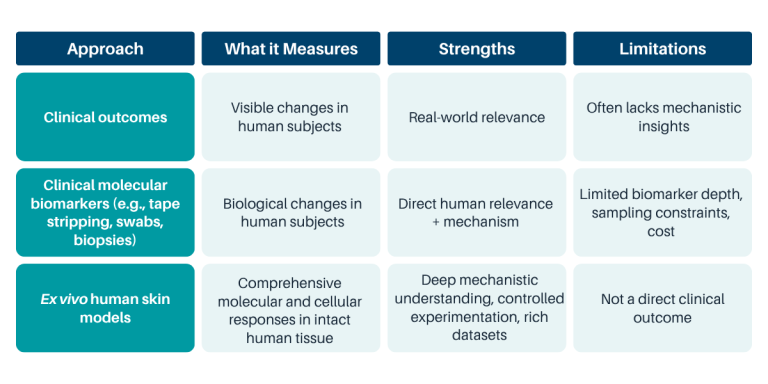
Molecular evidence can be generated in both clinical studies and controlled ex vivo models, but the two approaches answer different questions and have different practical strengths. Although both provide valuable mechanistic evidence, they answer different questions.
Clinical biomarkers provide evidence of biological responses directly in study participants and can link molecular changes with observed outcomes. However, sample availability, participant burden, biological variability and study cost can limit the range and depth of molecular measurements that are practical in vivo.
Ex vivo human skin models allow biological responses to be investigated under more controlled experimental conditions. Ten Bio’s TenSkin™ model preserves viable, biologically responsive human skin tissue, enabling researchers to investigate endpoints including gene expression, protein signaling, extracellular matrix remodeling and inflammatory pathways.
This deeper mechanistic insight helps researchers identify early biological responses, optimize formulations, and generate stronger scientific support for cosmetic claims. Rather than replacing clinical testing, ex vivo models complement clinical studies by explaining the biological mechanisms underlying the observed outcomes. Each provides a different layer of evidence, contributing to a more complete understanding of product performance.
Ex vivo models can help investigate:
- Which biological pathways are activated?
- What molecular mechanisms drive efficacy?
- Which formulation performs best?
- Which claims are scientifically defensible?
Clinical studies can help determine:
- Do consumers experience measurable benefits?
- Are improvements visible and statistically significant?
- Are the effects meaningful in real-world use?
Together, these approaches create a continuum of evidence that connects molecular mechanisms to clinical performance. Ex vivo studies can establish how a product influences skin biology, while clinical studies can confirm that these biological effects translate into observable benefits.
Why molecular evidence can strengthen cosmetic claims
Stronger scientific substantiation
Molecular data can provide objective evidence that formulation influences biologically relevant pathways associated with skin health, aging, barrier function, or inflammation. When interpreted alongside clinical or other efficacy data, these findings can provide a more complete scientific rationale for a claim.
More informed formulation development
Molecular screening can help researchers compare ingredients and formulations before moving into larger downstream studies. By measuring biological responses directly, development teams can identify promising candidates, investigate dose responses and make more informed decisions about which formulations to progress.
Understanding variation in skin responses
Skin biology varies across individuals and populations, influencing differences in barrier function, pigmentation, inflammatory responses, and aging processes. Where studies incorporate appropriately diverse human tissue, molecular analyses can help researchers investigate whether biological responses differ between donor groups and support a more detailed understanding of product performance across skin types.
More scientifically meaningful product communication
Molecular evidence can also help translate complex skin biology into clearer product narratives. Rather than communicating only that a product produced an observed benefit, brands may be able to explain the biological processes associated with that effect—provided the communication remains consistent with the evidence generated.
Within this evolving substantiation landscape, ex vivo human skin models play an increasingly important role by generating the mechanistic evidence that complements downstream clinical and consumer studies. Based on these developments, we propose a tiered framework for cosmetic claim substantiation that integrates mechanistic, clinical, and consumer evidence.
Building an integrated evidence pathway
Rather than viewing mechanistic, clinical and consumer evidence as competing approaches, they can be considered complementary stages within an integrated evidence pathway. The appropriate combination will depend on the product, the claim being made and the stage of development.
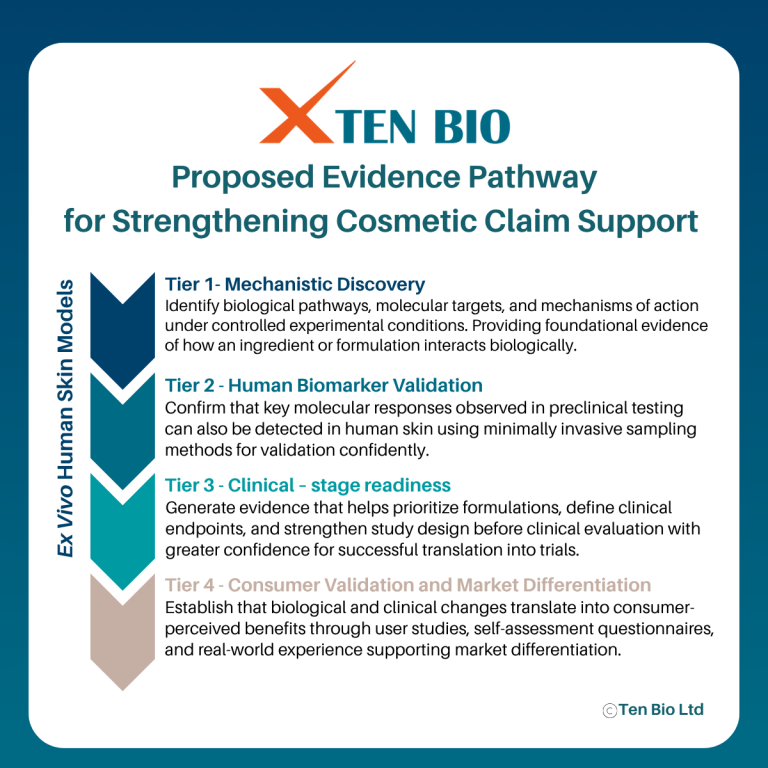
A development program might begin with mechanistic studies to identify biological responses and potential mechanisms of action. Selected biomarkers can then be investigated further, followed where appropriate by clinical evaluation of product performance and, ultimately, consumer-facing validation.
Conclusion
No single testing approach answers every question about cosmetic product performance. Clinical studies can demonstrate benefits in people, while molecular analysis and human-relevant ex vivo models can help reveal the biological responses associated with those outcomes.
The opportunity lies in bringing these evidence types together. By connecting mechanistic insight with clinical and consumer outcomes, researchers can make better-informed development decisions and build a more complete scientific case for product efficacy.
As cosmetic science becomes increasingly biology-driven, integrating evidence strategies will play an important role in translating advances in skin science into credible, well-substantiated product claims.
References
- MarketResearch. (n.d.). Worldwide cosmetic efficacy testing market research. https://pmarketresearch.com/worldwide-cosmetic-efficacy-testing-market-research/
- Charpentier, A. (2026, March 9). How skin biomarkers redefine efficacy claims and their scientific substantiation via ZOOM#35. Cosmetics Testing News. https://news.skinobs.com/en/how-skin-biomarkers-redefine-efficacy-claims-and-their-scientific-substantiation-via-zoom35/
- Javaid, H., Petrescu, C. C., Schmunk, L. J., Monahan, J. M., O’Reilly, P., Garg, M., McGirr, L., Khasawneh, M. T., Al Lail, M., Ganta, D., Stubbs, T. M., Sun, B. B., Vitsios, D., & Martin-Herranz, D. E. (2025). The impact of artificial intelligence on biomarker discovery. Emerging Topics in Life Sciences, 8(2), 89–105. https://doi.org/10.1042/ETLS20243003
- Brown, A., Passeron, T., Gilaberte, Y. et al. Biological Photoprotection: A Review of its Mechanisms, Evidence, and Clinical Implications. Dermatol Ther (Heidelb) 16, 3633–3648 (2026). https://doi.org/10.1007/s13555-026-01805-y
Ten Bio Team August 2026