FDA modernisation and the changing role of CROs in nonclinical testing
The move towards new approach methodologies (NAMs) is changing the landscape of nonclinical drug development. For pharmaceutical companies, the shift raises questions about which methods can provide the evidence needed to support clinical programmes. But much of the testing itself is delivered by contract research organisations (CROs). As regulatory expectations evolve, it is these providers that face a particularly important commercial decision: which capabilities should they build, buy or access through partnerships?
The regulatory context: from FDA Modernization 2.0 to 3.0
The US Food and Drug Administration (FDA) is one of the world’s leading regulatory authorities. Alongside regulators in Europe and elsewhere, its approach helps shape how new therapies are tested and evaluated. Recent developments reflect growing recognition of the need to reduce reliance on animal testing and make greater use of scientifically robust, human-relevant methods.
The FDA Modernization Act 2.0, signed into law in December 2022, amended US legislation to make clear that non-animal methods may be used in drug development. It did not ban animal testing or mean that all existing testing requirements disappeared. Rather, it opened the door more explicitly to alternatives such as computational (in silico) models, cell-based assays and organoids, microphysiological systems including organ-on-a-chip, and ex vivo tissue platforms.
The FDA Modernization Act 3.0 represents a further stage in this process. The Senate passed its version in December 2025 and the House passed its version in July 2026. As at October 2026, it should not be described as enacted law. The legislation seeks to accelerate updates to FDA regulations concerning nonclinical testing terminology. Separately, in September 2026 the FDA published a direct final rule alongside a companion proposed rule to update terminology in its regulations. The changes replace certain references to “animal” and “preclinical” testing with “nonclinical” terminology, recognising the wider range of scientifically valid methods available. The direct final rule is scheduled to take effect on 4 February 2027, provided no significant adverse comments require its withdrawal. It does not eliminate animal testing requirements or introduce new evidentiary requirements.
The FDA has also provided practical direction. Its April 2025 roadmap outlined steps to reduce animal testing in drug development, initially emphasising monoclonal antibodies and other biologics for which animal models may have limited human relevance. In March 2026 it issued draft guidance on considerations for validating NAMs, while its April 2026 progress report described implementation of the roadmap. The aim is to build confidence in evidence generated by alternative methods, including data submitted in support of investigational new drug applications.
Regulatory momentum extends beyond the US. In June 2026, the European Commission adopted a roadmap towards phasing out animal testing for chemical safety assessments across a range of legislative areas; however this is not a blanket removal of animal testing for new medicines. The UK’s November 2025 strategy similarly sets out a staged approach, including a target to apply validated alternatives for regulatory skin and eye irritation and skin sensitisation testing by the end of 2026. Together, these developments support the 3Rs: replacement, reduction and refinement of animal use.
Commercial developments are accompanying this regulatory momentum. A 2026 peer-reviewed economic assessment by researchers at Northumbria University examined 75 UK companies operating in the NAMs sector and found that their combined turnover increased from £947 million in 2021 to £1.24 billion in 2024, equivalent to annual growth of 9.4%. These totals also include wider company activities and should not be interpreted as NAM-specific sales. Looking at a more narrowly defined technology, BCC Research estimated the global organ-on-a-chip market at $153.2 million in 2024 and forecast $651.9 million by 2029. Although such forecasts remain uncertain, these findings indicate growing commercial activity, while individual advanced NAM technologies may still represent relatively specialised markets.
How will the pharmaceutical industry respond?
An understandable initial reaction is that this is not going to happen overnight. Drug development is highly regulated, capital intensive and necessarily cautious, with substantial investment already committed to established processes. The move to NAMs will therefore be gradual, and the pace will differ between technologies and applications. In practice, companies are likely to respond on several fronts: discontinuing animal procedures where robust alternatives are available; running established studies and NAMs in parallel to compare results and manage risk; discussing the acceptability of new evidence with regulators; and seeking guidance on the validation or qualification of novel methods. Pharmaceutical sponsors will still need to define the data packages required for their development programmes.
Importantly, the commercial role of NAMs extends beyond replacing animal studies required for regulatory submissions. Human-relevant platforms are already used in discovery and development to investigate biomarker validation, mechanisms of action, target engagement, drug delivery and tissue-specific responses. Such applications can inform internal research and development decisions without requiring formal regulatory qualification of the method.
However, the operational challenge is not pharma’s alone. A substantial proportion of nonclinical testing is undertaken by CROs, alongside work performed internally and in academia. It is CROs that must be ready to offer the methods, expertise and reproducible data their clients require. That makes the transition to NAMs as much a question of CRO strategy as of regulatory policy.
Build, buy or partner?
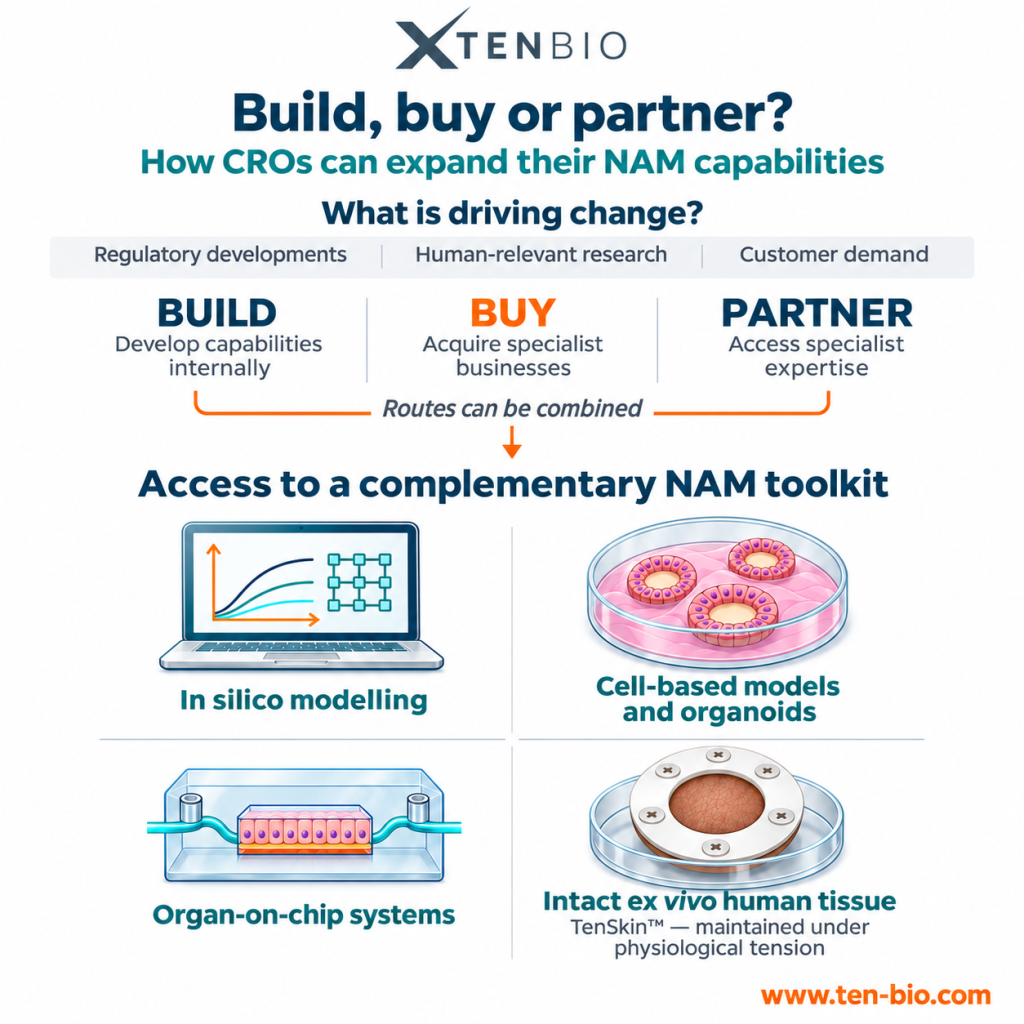
How do CROs develop these capabilities while remaining competitive? The familiar strategic question is whether to build or buy. There is also a middle way, increasingly prominent across life sciences: strategic partnerships and collaborations with specialist technology providers.
Charles River offers a useful example. Its published NAM strategy highlights collaboration with external organisations to develop and bring new technologies into its services, alongside investment in its own capabilities. The company explicitly identifies partnerships as a means of advancing the adoption of NAMs. This illustrates how a major CRO can expand its portfolio without necessarily developing every specialist platform itself.
The build-or-buy decision is not limited to CROs. In July 2025, life-science tools group Sartorius acquired MatTek, a developer of human cell-based microtissues and 3D tissue models, to strengthen its portfolio of advanced models for drug development. The acquisition illustrates the strategic value that established life-science businesses may place on specialist NAM technologies and their integration into broader commercial offerings.
The same strategic choices are likely to arise across the wider CRO market. Established providers can invest in technologies close to their current expertise, assess specialist platforms as potential partners and, where justified, consider acquisitions. An interesting and recent example of consolidation is the action of SenzaGen AB building its portfolio of providers of NAM solutions. VitroScreen and ToxHub have been joined by Alcyomics in Newcastle, UK, which offers non-animal, human-relevant immunotoxicology services to biopharma.
For developers of novel NAMs, the question is whether they can demonstrate sufficient scientific and commercial value to become part of that expanding offering. For regulatory use, the priority is to demonstrate that a NAM is sufficiently validated and fit for its intended context of use. Formal FDA qualification is not a universal prerequisite for every NAM or research application. However, that status and the opportunity for the much broader application of the NAM platform remains an eventual, desirable result.
Making room for the full NAM toolkit
Much of the current discussion focuses on in silico modelling, organoids and other cell-based assays, and organ-on-a-chip systems. These are important technologies, but they do not represent the full range of approaches available. None can reproduce the complete complexity and connectivity of human biology, and all face questions about the evidence needed to support particular uses, as well as scalability and cost.
Intact human tissue maintained in ex vivo platforms is another important option. Unlike simplified cell-based systems, it can retain native tissue architecture, extracellular matrix and interactions between resident cell populations. In skin research, this can provide a relevant setting in which to examine local responses to topical treatments, injections or other interventions. For physical interventions such as microneedling or injection, preservation of the relevant tissue’s mechanical properties can be essential in generating physiologically meaningful results. Such models can therefore contribute a different kind of human-relevant evidence within a complementary NAM toolkit.
This does not mean that ex vivo systems replace every other method, or that all tissue platforms have the same capabilities. Their suitability depends on the biological question, the model’s demonstrated performance and the evidence required. Limitations can include finite culture periods, donor variability and the absence of systemic circulation. The important point is that regulatory and commercial decisions should consider the full range of NAMs rather than only the most prominent categories.
What trends and outcomes might follow?
- Larger CROs are likely to continue investing in NAM capabilities that are closest to their existing expertise, particularly computational methods and established cell-based assays.
- Specialist platforms may become attractive partners where they fill gaps in a CRO’s offering, while selective acquisitions could provide another route to accessing differentiated capabilities.
- We can see evidence of consolidation in the NAM provider segment of the market as smaller businesses aggregate to develop more expansive propositions.
- Validation, reproducibility and evidence of fitness for a defined purpose will be central to decisions about adopting, partnering with or acquiring a NAM technology.
- Safety and toxicity assessment will remain an important regulatory focus, while NAMs are already increasingly used in discovery and development to investigate efficacy-related responses, target engagement and mechanisms of action.
- Better nonclinical data may help inform clinical trial design and development decisions, although shorter development timelines or faster approvals cannot be assumed.
- The commercial rewards could be significant for successful providers, with the potential for further change and consolidation in the CRO market.
Conclusion
The shift away from routine reliance on animal testing is gaining momentum, although adoption of NAMs will not be uniform or immediate. The more agile CROs may respond by augmenting their portfolios through a combination of building, buying and partnering. Those choices could influence both the speed at which new methods become available to pharmaceutical sponsors and the competitive landscape for nonclinical testing.
For developers of more novel NAMs, including organ-on-a-chip technologies, organoids and ex vivo platforms that maintain tissue integrity, the emphasis must be on robust evidence. CROs and pharmaceutical sponsors are understandably cautious about risk. Clear validation strategies, reproducible results and well-defined applications will be essential to wider uptake. For CROs, the strategic priority is access to scientifically differentiated, fit-for-purpose capabilities that can be delivered reliably to clients, whether developed internally, acquired or accessed through partnerships. New strategic investments are inevitable as companies look to capitalise on the accelerating shift towards non-animal testing.
Sources
- FDA Modernization Act 3.0, H.R. 2821, House-passed text (20 July 2026). https://www.govinfo.gov/app/details/BILLS-119hr2821eh
- US Congressional Record, Senate passage of S.355 (16 December 2025). https://www.govinfo.gov/content/pkg/CREC-2025-12-16/pdf/CREC-2025-12-16-pt1-PgD1276.pdf
- FDA, direct final rule on nonclinical testing terminology (22 September 2026). https://www.govinfo.gov/content/pkg/FR-2026-09-22/html/2026-19350.htm
- FDA, roadmap announcement (10 April 2025). https://www.fda.gov/news-events/press-announcements/fda-announces-plan-phase-out-animal-testing-requirement-monoclonal-antibodies-and-other-drugs
- FDA, draft guidance on NAMs (March 2026). https://www.fda.gov/regulatory-information/search-fda-guidance-documents/general-considerations-use-new-approach-methodologies-drug-development
- FDA, roadmap first-year update (20 April 2026). https://www.fda.gov/news-events/press-announcements/fda-achieves-year-1-goals-reducing-animal-testing-drug-development
- European Commission, roadmap on animal testing for chemical safety assessments (1 June 2026). https://single-market-economy.ec.europa.eu/publications/roadmap-towards-phasing-out-animal-testing-chemical-safety-assessments_en
- UK Government, replacing animals in science strategy (11 November 2025). https://www.gov.uk/government/publications/replacing-animals-in-science-strategy/replacing-animals-in-science-a-strategy-to-support-the-development-validation-and-uptake-of-alternative-methods
- Charles River, NAM strategic partnerships. https://www.criver.com/about-us/about-us-overview/new-approach-methodologies/partnerships
- Sartorius, acquisition of MatTek (completed 1 July 2025). https://www.sartorius.com/en/company/newsroom/corporate-news/sartorius-completes-acquisition-of-mattek-1701286
- Johnson, E., Reed, H., Thew, A. and Johnson, M. (2026), UK NAMs sector economic assessment, NAM Journal. https://doi.org/10.1016/j.namjnl.2026.100102
- BCC Research (April 2025), Organ-on-a-Chip: Global Markets (BIO188C). https://www.bccresearch.com/market-research/biotechnology/organ-on-a-chip-markets-research-report.html
Ten Bio Team November 2026