From prediction to proof: the complex challenge of validating AI-generated insights
Advances in molecular biology, high-content imaging, multiomics technologies, wearable sensors, and computational methods are transforming how researchers study human skin. Researchers can now measure gene expression, protein abundance, tissue architecture, barrier function, immune responses, and other biological variables in parallel, generating datasets that capture multiple layers of skin biology.
These datasets create unprecedented opportunities, but also new challenges. As biological data become larger and more complex, conventional analytical approaches may struggle to identify the relationships that matter most. This has driven growing interest in artificial intelligence (AI) to integrate diverse data types, identify molecular signatures, uncover relationships between pathways, and predict how skin tissues may respond to aging, disease, and treatment.
However, prediction is not the same as biological proof. AI learns patterns from the data on which it is trained. If those datasets are incomplete, poorly characterized, or generated using experimental systems that do not accurately reflect human skin physiology, the resulting output may be statistically convincing without representing genuine biological mechanisms.
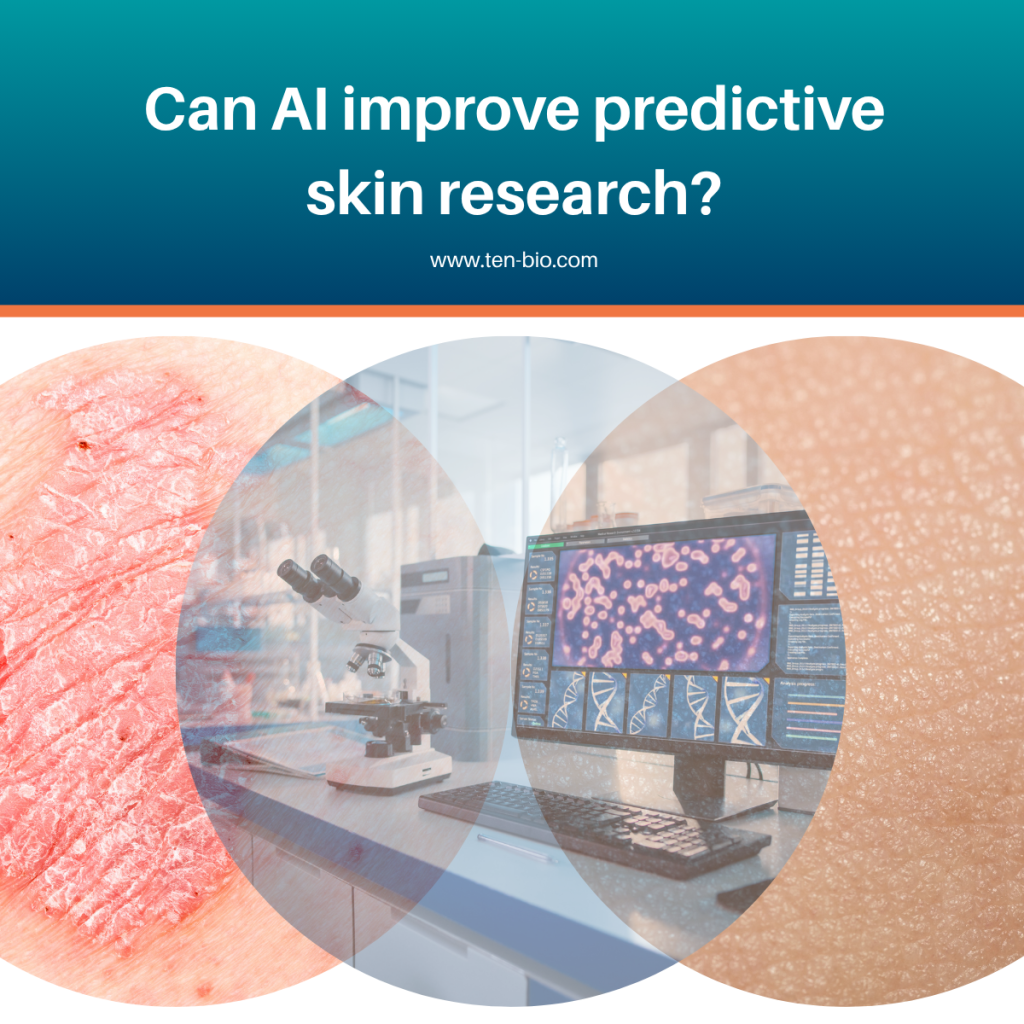
Are we moving from descriptive to predictive skin research?
Early applications of AI in dermatology focused heavily on descriptive and image-based tasks, including lesion recognition and the differentiation of melanoma and non-melanoma skin cancers. Encouraged by progress in diagnostic applications, researchers are now exploring more predictive approaches that integrate multi-level information to anticipate biological responses before they become clinically apparent.1,2
By integrating longitudinal datasets with genomics, proteomics, biomarker measurements, and physiological parameters, AI may help identify biological signatures associated with skin aging, inflammation, regeneration, and treatment response. 3,4 This could support earlier identification of promising interventions, improve understanding of mechanisms of action, and help anticipate treatment responses before visible effects emerge.
The integration of diverse biological datasets with AI models may reveal relationships that are difficult to detect using conventional statistical approaches. This can help identify biomarkers and biological pathways relevant to skin health and disease, while generating hypotheses that can be tested experimentally.3,5
For example, computation analyses of transcriptomic datasets from patients with psoriasis have identified gene signatures associated with disease severity and treatment response. Similarly, multi-omics analyses incorporating microbiome, immune, and gene expression data have provided insight into mechanisms underlying atopic dermatitis flares and disease heterogeneity. 6 These examples illustrate how AI and computational methods can help move skin research from description toward prediction, but they do not remove the need for biological confirmation.
Where can AI support skin research – and where does it fall short?
AI can help uncover biological patterns within complex datasets by integrating information across molecular, cellular, tissue, and clinical levels. This may enable researchers to identify biomarker signatures associated with tissue remodeling, barrier function, immune activation, and therapeutic response, helping to connect observed changes with the mechanisms that may drive them.1,2
However, identifying a pattern is not the same as proving a biological mechanism. Predictive models can generate plausible hypotheses, but those hypotheses still need to be tested in systems that preserve the relevant features of human skin biology. This is where physiologically relevant human skin models become important: they can generate richer datasets and provide a validation environment in which computational predictions can be linked to functional tissue responses.
AI falls short when training datasets are biased, incomplete, poorly characterized, or generated in simplified systems that do not reflect the biology of native human tissue. In those situations, models may perform well mathematically while failing to capture the physiological processes that determine whether a target, active ingredient, formulation, or delivery technology will work in practice.
Could AI create a validation bottleneck?
As AI tools become more widely used in discovery and development, one emerging challenge is that the bottleneck may shift from generating candidates to validating them. AI can support target identification, compound screening, molecular design, lead optimization, formulation development, and biomarker discovery, but each AI-generated candidate or hypothesis still requires experimental validation before it can support product development decisions or progression toward clinical evaluation.
This is particularly relevant for skin research. AI may increase the number of predicted APIs, formulation strategies, delivery approaches, ingredient combinations, or biological targets, but it cannot by itself confirm whether those predictions produce the intended response in human tissue. Reviews of AI-enabled drug discovery highlight that validation of predicted targets, data quality, model generalizability, and prospective validation remain key challenges, even as AI accelerates early discovery.7
How critical is data quality to AI’s predictive power?
Skin is a data-rich interface, as discussed in our previous article on wearable technologies and data such as barrier function, hydration state, perfusion and microcirculation, immune activity and mechanical stress can now be measured, adding to the library of skin information currently available. Its function is influenced by mechanical forces, extracellular matrix organization, immune signaling, and cellular communication. Capturing these complex biological interactions within experimental datasets may help AI models generate predictions that are more reflective of in vivo tissue behavior.3,4
Now, AI systems are only as reliable as the biological quality, diversity, and physiological relevance of the data used to train and validate them. Larger datasets may improve model performance, but volume alone does not guarantee biological accuracy nor valid insight. Models trained on biologically limited datasets may produce mathematically accurate predictions without capturing physiologically relevant biology. As a result, the predictive power of AI depends not only on advanced computational methods, but also on the biological quality of the data used for training and validation.3,4,5
For predictive skin research, AI should therefore be viewed as a tool for extracting biological insight rather than a replacement for biological experimentation. Its value depends on the quality, physiological relevance, and translational potential of the underlying datasets, as well as the strength of the experimental systems used to validate their predictions.
By more closely reflecting native human skin biology, physiologically relevant tissue systems can improve the translational value of AI-driven predictions and help determine which computational signals are worth advancing.
What does the future of predictive and translational skin science look like?
The future of skin research will likely depend on increasingly integrated experimental and computational approaches. AI tools may help researchers identify biomarkers, uncover mechanistic pathways, and connect molecular changes with functional tissue outcomes. However, the success of these approaches will depend on the quality, diversity, and physiological relevance of the underlying biological data, and on the ability to validate predictions in human-relevant systems.
Ultimately, AI should be viewed as a tool that complements biological experimentation rather than replacing it. As AI increases the speed at which new hypotheses and candidates can be generated, experimental validation will need to keep pace. Translating predictive signals into validated biological insight requires systems that preserve the complexity of human skin while remaining experimentally tractable.
Ten Bio contributes to this validation layer through its ex vivo human skin models and specialist research services, supporting the generation of data that reflects native tissue responses. TenSkin™ maintains tissue viability and responsiveness through next-generation culture technology, enabling investigation of complex, multi-factorial processes such as wound healing, barrier function, and skin rejuvenation. By providing data that more closely reflects native human skin biology, Ten Bio helps translate predictive signals into validated biological insights within physiologically relevant systems.
In this context, advanced human skin models should not be viewed only as standalone testing tools. They are part of the translational infrastructure needed to close the gap between computational prediction and biological confirmation, helping ensure that AI-driven discovery can progress with confidence toward clinically and commercially relevant outcomes.
References:
- Aljohani, B. H. S., Yafooz, W. M. S., & Alsaeedi, A. (2026). AI-driven dermatological diagnostics: A systematic review of machine and deep learning methods for skin disease classification. Array, 30, 100797. https://doi.org/10.1016/j.array.2026.100797
- Zbrzezny, A. M., & Krzywicki, T. (2025). Artificial Intelligence in Dermatology: A Review of Methods, Clinical Applications, and Perspectives. Applied Sciences, 15(14), 7856. https://doi.org/10.3390/app15147856
- Chen, X., Zhou, Z., Ding, H., Zheng, H., & Ge, Y. (2025). Transforming aesthetic dermatology: The role of artificial intelligence in skin health. Dermatology and Therapy, 15(8), 1999–2013. https://doi.org/10.1007/s13555-025-01459-2
- Haykal, D. (2024). Emerging and Pioneering AI Technologies in Aesthetic Dermatology: Sketching a Path Toward Personalized, Predictive, and Proactive Care. Cosmetics, 11(6), 206. https://doi.org/10.3390/cosmetics11060206
- Ceylan, S., Demir, D., Harris, C., İpek, S. L., Vavourakis, V., Manca, M., Dubrac, S., & Bauer, R. (2025). Skin in the game: A review of computational models of the skin. BioData Mining, 18, Article 55. https://doi.org/10.1186/s13040-025-00471-8
- Rider, A., Grantham, H. J., Smith, G. R., Watson, D. S., Casement, J., Cockell, S. J., Gisby, J., Foulkes, A. C., Henkin, R., Iqbal, W. A., Ewen, T., Amarnath, S., Ng, S., Zuliani, P., Dand, N., Stocken, D., Traini, C., Thomas, E., Kalyana-Sundaram, S., Rajpal, D. K., … PSORT consortium (2026). Transcriptomic profiling and machine learning uncover gene signatures of psoriasis endotypes and disease severity. Communications medicine, 6(1), 65. https://doi.org/10.1038/s43856-025-01325-4
- Riemer, A., & Freund, V. (2026). Generative artificial intelligence in pharmaceutical drug development: A systematic review of time and cost efficiency across discovery, preclinical, and clinical phases. Intelligent Pharmacy, 4, 145–158. https://doi.org/10.1016/j.ipha.2025.12.006
Ten Bio Team July 2026